


B2B Internet Mktg
Diligent Internet Marketing Boosts Sales, Generates Leads
Internet marketing is all about driving more qualified traffic to your website in order to acquire leads and build relationships with customers and prospects. A strong internet marketing strategy is essential to the success of your business.
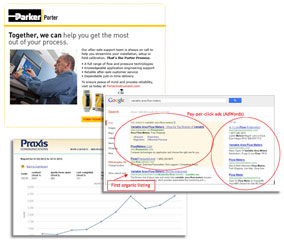 Praxis specializes in and understands the needs of B2B marketers and their customers. We can put together an internet marketing strategy that will help you increase your visibility on the web. Our arsenal of tactics to drive site traffic and generate more inquiries includes:
- Search Engine Optimization (SEO)
- E-Mail Marketing Campaigns
- Permission Marketing
- Key Word Sponsorship & Bid Management
- Linking Strategy & Acquisition
- Directory Sponsorship
- Banner Ads
- Pay Per Click (PPC)
Whether your goal is to win top search engine rankings, build customer relationships through permission email marketing, or get the most bang for your Google AdWords buck, Praxis can help you succeed.
B2B Internet Mktg
Advanced Search Engine Optimization Methods, Praxis-Style
Optimizing for search engines can be tough, but in today’s business climate it's vital. Fortunately, it's becoming more cost-efficient and more effective than any other marketing option for those companies that want to succeed.
SEO gets the people who want to buy your products to your site. Everyone goes online to source products. And often, these people don't know the "top branded vendors" and don't have time to find out.
Everyone looks at the companies that come up at the top of Google. If your company is near the top on Google and look credible, it puts your company in the running for a sale. People may even assume your company is a top brand, whether you are or not. Did you know that:
- 75% of the clickthroughs occur on the top 5 listings.
- Directories like Thomas Register and Globalspec advertise for products on Google.
- The top of Google rankings is also where you will find Praxis search-optimized customers.
- One of our clients currently ranks #1 on Google for 13 of 14 primary search terms. Half the leads off their website are from people who found them through search engines.
- Another Praxis client launched their site a number of months ago and now ranks #1 to #3 on Google for 15 of 16 primary search terms.
- And a company whose site we just launched is already #1 for several search terms while the rest of their terms are steadily climbing. These clients are generating more sales opportunities by increasing their web traffic. You can do the same for your company's web site.
And a company whose site we just launched is already #1 for several search terms while the rest of their terms are steadily climbing.
These clients are generating more sales opportunities by increasing their web traffic. Let Praxis help you do the same for your company's web site.
Improving Search Engine Rankings: An Ongoing Quest That’s Worth It!
Search Engine Optimization (SEO) is a hot topic that's only getting hotter as more buyers and specifiers use search engines almost exclusively to find what they're looking for.
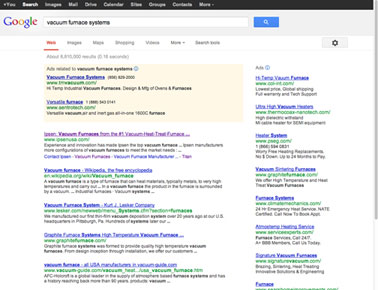 Every company wants its site to be ranked high on page one of the search engine results page, but this is getting harder by the minute. While nobody outside the engine programmers knows for certain, there has been much discussion about how the engines’ algorithms favor certain types of content – particularly non-commercial editorial. But since this changes almost daily, web developers are left to use a variety of techniques that have proven successful in the past and keep tweaking them.
In any case, there's no guarantee that today's #1 ranking won't be a #20 ranking next month. So, what is one to do?
The key to successful SEO is to understand how searchers search, and how the engines are built to accommodate them. The kind and amount of keyword-rich text is critical; link popularity is vital; the importance of the specificity of a search string (term) that a user might employ to drill down to a reasonable result can't be overstated.
When you hire Praxis for SEO, we make sure your index page has plenty of keyword-rich content that describes your product or service in the terms your audience will use to find you. We’ll include an About Us page that helps the engine crawlers index your category properly, and employ additional content links at the bottom of each page that describe your product and service.
We’ll also supplement your site with plenty of editorial content that is relevant to a searcher's interests (Google particularly favors such non-commercial, editorial copy).
Improving link popularity by increasing the number of links to your site from outside sources, such as reps, distributors, and buyers’ guides also helps search engines find your site. This can be accomplished by increasing the number of public relations items you release – news items in the electronic media will show more high-level results linking to your site, either directly or indirectly.
Here are a few of the steps Praxis will take when you partner with us for an SEO program:
- Evaluation of your current site, and creation of a spreadsheet of new keyword-rich phrases.
- Addition of an About Us page, internal linking structure, and editorial content to improve the overall value of your site in the eyes of the crawlers.
- Development of third party links back to your main site through a variety of trade channels including paid directories, keyword buys and sponsorships, as your budget permits.
- Writing and distribution of news-worthy public relations activities such as press releases, articles and case studies.
- Analysis of your website’s ranking on a monthly basis using keyword reporting software.
B2B Internet Mktg
B2B Internet Marketing Leads & Conversions
Wouldn't it be great if you knew what keywords triggered the most RFQs, or which creative message resulted in the best ROI from your media buy?
Well, you can. But you need a good analytics system and you need to know how to access and read the data you're interested in. Unfortunately, that's easier said than done.
Fortunately, one of the best analytics systems on the market is free (Google Analytics), and it's easy to set up. But it takes a lot of time and knowledge to riddle out the useful data from all the possible reporting options, and most people we work with simply don't have time because they are already multi-tasking in a sales and marketing role along with many other responsibilities.
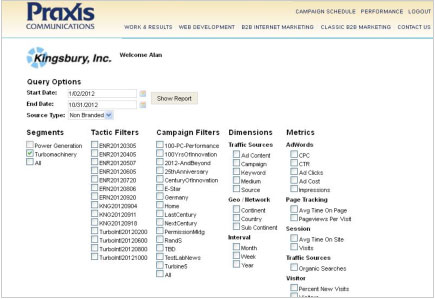
Praxis has developed a media tool that is available to every client that allows the user to log in and view all of this data in any of a number of different reporting options. Each client dashboard is unique to a specific website and media plan, and reports data from Google Analytics in a much easier and more understandable way. Here's an example of a typical client dashboard showing all the relevant choices for that particular client's program:
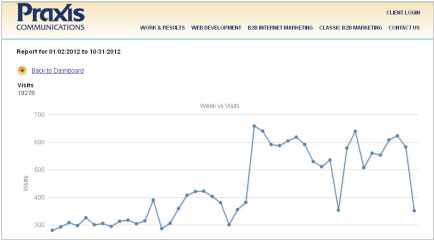
And here's an example of one kind of Analytics report showing non-branded visits in a selected time frame:
Clickthroughs can come from lots of different sources, i.e.:
- Organic non-branded search
- Pay-per-click advertising, such as Google AdWords
- Media such as online banners and newsletter sponsorships
- Directories such as ThomasNet or DirectIndustry
- Email marketing, either third-party or by permission from your own database
- Incoming links from press releases you issue or via social marketing
To figure out which traffic makes the most difference – and thus, to determine where to put your time and money – you need to understand what happens when these clickthroughs hit your website. So, a big part of setting up analytics includes tagging every incoming link we can with a specific URL that identifies the source and date, the campaign name, the content and the landing page. From reviewing history of all this data, the client can make better future decisions on where to spend money, what messages are more effective, and what changes they should make on the landing page to get better conversions.
Tags can be placed on online media, on email marketing links, on press releases, and even on pay-per-click advertising. About the only thing we can't tag is organic search, but we have other ways to measure its performance.
But not only can the client see where clickthgroughs are coming from, he can also see how many from each source resulted in a conversion action, that is, for instance, how many people opened a PDF, viewed the Contact page, requested more information or a quote, etc. He can even view form abandonment rates. Here's an example of various goals on one of our clients' websites:
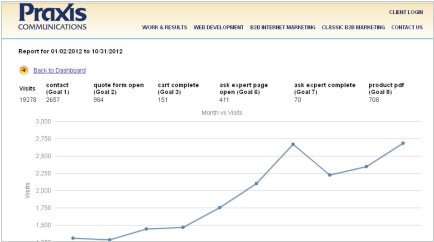
A good analytics program is vital to the website's success as a lead generation tool. You can only improve its ROI if you can see it; otherwise, you're just guessing. We put the time and effort into building a custom tool to share with our clients so they can understand what's going on and collaborate with us in improving their website's traffic, media and conversion performance.
Creating Loyalty With Reps And Distributors
If your company depends on independent channels (representatives, agents or distributors) to sell your products and you’re not getting the attention you desire from them, chances are a Praxis channel marketing program will help.
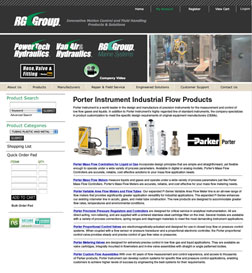 Often, your sales channels represent several other manufacturers as well, so keeping them focused on your business can be difficult, particularly if your product is a complicated sell. Sales reps or distributors usually go for the easy money, so anything with a long or complex sales cycle tends to get back-burnered. But there's a reason these folks signed up with you in the first place, and it's a good idea to remind them frequently of your value to their bottom line, and to support them in any way possible.
There are a number of ways to create more loyalty – and sales opportunities – from your channels. One of the simplest and most successful methods is to send a regular e-mail news brief highlighting sales tips, new product announcements, links to new web content, or a variety of other news items. The trick is to make sure it gets done regularly, and that it's brief and grabs the reader’s attention. The real value, aside from delivering important content, is to create top-of-mind awareness so the sales representative keeps your company in mind when making calls.
Another tactic is to create a channel-only intranet that provides valuable content to help the sales agent sell your product in his markets. This site can deliver product-specific material to aid in customer presentations, provide competitive comparisons to illustrate your product’s value benefits, and, if appropriate, offer specifications and pricing models. And since sales folks would much rather be out on the road selling than spending time in the office, intranet content must be compelling, easy to navigate, and frequently updated.
Once built, the intranet site should be promoted to your channels as a valuable resource (which also makes good fodder for those e-mail news briefs).
Here’s what Praxis will do to ensure that your channel marketing efforts pay off:
- Establish a schedule for releasing the e-mail news briefs and setting guidelines for frequency so your audience doesn’t feel “spammed” by too many emails.
- Design an inviting, eye-catching HTML layout that doesn't take up too much room in the recipient's e-mail window.
- Work with you and your staff to establish key topics and write content for the first four or five news briefs, to ensure that you are prepared for each issue weeks ahead of your distribution dates.
- Design and develop the intranet site and start populating it with good content, including lots of easy-to-find company contacts.
Increase Brand Awareness And Customer Loyalty Through E-Marketing
Is your B2B company looking for ways to cement customer loyalty and increase market share? An integrated e-marketing campaign of newsletter sponsorships, card decks, and buyers’ guides may be the way to go. These on-line marketing communications tools generate invaluable interest among prospects and customers, yet don't require a major investment to implement.
 Best of all, each tactic in your e-arsenal can aim at a slightly different target. Newsletter sponsorships, for example, lend themselves well to both company and product presentations, while e-decks and buyers’ guides offer a two-pronged approach to product promotions, with e-decks generating immediate inquiries and buyers’ guide listings maintaining a solid brand presence throughout the year.
Praxis helps clients take full advantage of the bounty of opportunities out there. Not only will we plan and deploy tactics that will link back to your website, we’ll make sure your site is equipped with plenty of good content so that visitors can easily find what they’re looking for. We'll also build in conversion tools to encourage them to take an action.
When you partner with Praxis for e-marketing, we'll:
- Evaluate the specific audiences your products and services serve.
- Determine who within the audience buys or recommends the purchase of your products.
- Analyze the top publications, media properties and direct marketing opportunities in your target industry segments that accept sponsorships.
- Create content that is simple, direct, and compelling.
- Create links from the message that refer prospects to specific pages of content within your web site that fulfill the product or brand promise.
- Track the response so that you can see the ROI from your advertising dollars.
Getting Your Site Visitors To Register, Or Opt In, For Permission Marketing
One of the most important functions your web site can provide is lead generation. Incorporating a permission marketing tool into your site is a highly effective way to accomplish this.
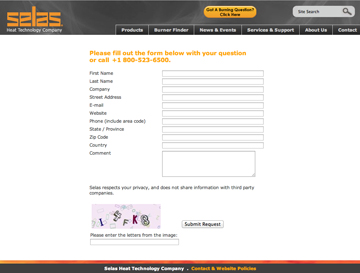 Permission marketing involves creating premium content that has specific value to your audience – technical tips, product spec sheets or white papers, for example and asking them to register their name and email address in order to access that content. By doing this, a site visitor is giving you permission to send them relevant information from your company in the future.
Once you've obtained this permission from your prospects, your marketing will take on three exciting characteristics. It will be anticipated, meaning people will actually look forward to hearing from you. It will be personal, meaning the messages are aimed directly at the prospect. And it will be relevant, meaning you know for sure that the marketing is about something in which the prospect is interested.
Here are some of the steps Praxis takes when establishing a permission marketing campaign:
- Create an area on your website where viewers can access valuable premium content.
- Create a place where they can register to receive content now or in the future.
- Develop a registration form that must be completed in order to get that content.
- Create a privacy statement and an opt-in/opt-out component on anything you send to a permission marketing member.
- Create a way to account for and benchmark your success in closing business with these methods.
- Change content routinely, and create an archive section for older content.
Above all, permission marketing is about building relationships with people who agree to learn more about your company and its products or services.
For help creating a permission marketing program for your business, contact Praxis.
B2B Internet Mktg
Internet Marketing: More On Links (And Moron Links)
by Jeb Blair
One of the biggest Google ranking factors is incoming links to a website, also called backlinks. More specifically, Google considers the number, the quality, the content relevance, the trust factor, and the "weight" of the links coming to your website, as well as what are likely less important aspects like recency.
Many people trying to improve their rank on Google for their search terms get involved with trying to increase the links to their website. This is generally seen as a difficult and time-consuming task. Before you start it is important to have a general appreciation of each of these aspects:
Number of Links: Having a lot of links to your site is good, but not necessarily great. Historically (in ancient optimization history, like 10 years ago) people would request links from other webmasters. This is no longer done except with partner sites since no one really cooperates any more. Here is what is done now to increase (or decrease) links.
Directories: Adding your website listing to directory websites has been a popular SEO tactic over in the last 10 years although it has waned a bit. Google has waffled on the value of this: At one point they said they discounted all directories as having no value, but they have backtracked a bit since there were obviously a few directories providing good value – some of which were owned or supported by Google. Currently they say that directory listings can have some value if the directory site also provides free listings. That brings us to the next item: Buying links. In general, getting links from directory listings where you only get your name and contact information along with a hundred other companies on the same page qualifies as a "moron link".
Buying links: Presumably it is strictly verboten to sell/buy links in order to build ranking on Google. In fact, they encourage people to rat out other companies who they suspect of buying/selling links! This is likely because they have a hard time detecting it in some circumstances. The fact is that it goes on all the time, either explicitly or implicitly. Google has allowed some form of payment for directories. Obviously Google discounts links that come in from advertising, although they probably use it somehow in rankings.
Media sites: Media websites are a top target of link development today. Press releases, articles, etc. are all good sources of links. This might be considered the current target of choice for link development instead of directories. For more information, see Alan Gladish's article in this same issue.
Viral content: This is deemed content on your website that is so inspiring or interesting that people share it and want to create links to your website. In the B2B world this can be hard to do, but there are some types of content that are more viral in nature, and hence more likely to foster link development. Blogs and forums are useful. Technical content of general interest is usually good – like industry standards, regulations, industry news, etc.
Link farms: Some webmasters create networks of websites that link to one another. This can be tricky for Google to detect in some circumstances since it can also be a valid thing to do. General Motors, for instance, has a lot of websites for its brands and they link together. Other companies have taken it a lot farther and it is possible to join link farms. But like Groucho Marx not being willing to join any club that would accept him as a member, you should be wary about joining any link farm that would solicit you by promising dozens of instant links (automatic "Moron Link").
Nofollow, noindex, robots.txt, bounced links, etc: There are a lot of ways to provide a link that has no search ranking value (another "Moron Link" category). This will be the topic for a future posting – or you can call me if you need to know right away.
Photos, videos, and the like: This is a burgeoning source of links that holds promise for many companies and merits further research.
Quality of Links
Content relevance: If a linking web page is thematically related to your website, or otherwise uses the exact terms being used in your website, the value to your ranking for that content or search terms is elevated.
Trust factor: If links come from web sites/pages with high trust factors (universities, government, and to a lesser extent websites not involved in any search engine hanky panky) the link is likely worth more.
Weight (or PageRank): If the link comes from a page with a high PageRank (named after Larry Page, one of the founders of Google), it can provide more value. This is the measure of how much of a node the page is within the Internet (see Wikipedia for a definition). PageRank can be identified by installing the Google toolbar on your website using the PageRank option. Oftentimes, it is more useful to see pages without any PageRank, since that is where your link opportunities usually come from. If there is zero PageRank, there is not likely to be a lot of value from that webpage, but sometimes that's the only target you get.
Well, if that was more than you wanted to know about links, give Praxis a call so we can handle the endless details involved with the optimization of your website. Got a question? Email me at jblair@praxisagency.com.
B2B Internet Mktg
B2B Internet Marketing Pay-Per-Click
Pay-per-click advertising is what made Google one of the richest and most powerful companies in the world, so you might think "Why give them my hard-earned money?" Well, the reason people are so anxious to spend money on Google is because they deliver a really good product with a tremendous ROI. And it's relatively democratic too. You compete for position and traffic with other advertisers by outsmarting them, not just out-bidding them.
Let's take a step back and talk a little about how Pay-per-click, or PPC, works. Google's official name for their PPC program is AdWords. These ad listings often appear at the top of a search on Google, and also on the right side of the search results page. Companies who want to advertise here sign up for a Google AdWords account (or hire a third-party consultant to do it), and create "campaigns" and specific ads designed to appear (i.e., make an "impression") when certain keywords are triggered in a search.
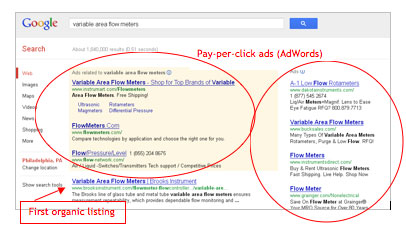
Every time someone clicks your ad, two things happen:
- The user is transported to your landing page where (hopefully) you've designed an inviting space to engage him/her in your content and encourage a conversion; and
- Google charges your account an amount up to but not exceeding your bid price. You set a maximum daily budget; when enough people have clicked your ad in any given day to reach your limit, Google stops presenting your ad.
The clickthrough rate (CTR) is represented by the number of people who clicked the ad divided by the number of impressions in a certain period. The higher that number, the better. The cost-per-click (CPC) is the actual amount that Google charges your account every time someone clicks on your ad. The lower the number, the better.
In every analysis we've done year after year, PPC continues to outperform directories such as ThomasNet by at least a 10:1 margin in traffic, and the inverse in cost. For example, while a $200 monthly budget in AdWords can easily yield 100 clickthroughs, ThomasNet programs often cost $1,000 per month and only deliver half that traffic. While the engagement level tends to be a bit higher with somewhat greater intentionality from a B2B directory, it hardly makes up for the enormous difference in cost and effectiveness.
So generating leads to your website from search terms that you can't rank for organically is one good reason to consider a PPC program. But there is another equally important reason, namely, research. This is particularly relevant if we have very little historical background on site traffic from which to make decisions regarding organic search engine optimization. Testing a variety of messages and keywords in a PPC program can tell us a lot over a relatively short period of time about what kinds of terms and messaging are good, which are bad (eg, possibly those comingled with unrelated terms that we wouldn't know otherwise), and how competitive it will be to rank for organic search.
While Google isn't the only company offering a paid search program, it is definitely the 800 pound gorilla at the moment, and it looks like it intends to stay there. If you can succeed with a Google AdWords campaign, you will be able to translate those skills to other providers down the road.